Interesting anniversaries, plus an update on my current work-in-progress

Yeah, again it’s been a while since I posted. And I still don’t know how people get the time/motivation to post regularly, let alone frequently!

I noticed several of my writing-related anniversaries pop up this month. Every one of them has some form of connection to my current work-in-progress, oddly. So I decided to recognize/celebrate them with a blog post today.

I’ll go chronologically, because that’s just how I roll.

In October 2012, my debut novel, The Genesis Code, was accepted for publication by DarkFuse (they have since closed down, and I’m with Crossroad Press now). Genesis came out in May 2013, and is still out there, republished by Crossroad in all forms (ebook, paperback, and even audiobook!). How is Genesis related to my current work-in-progress, you ask? Well, one of the characters, Dr. Josh Tyler, invented a mind-control sort of implantable chip in Genesis. He will return with a new generation of the darstardly device, powered by more modern technology like AI, TinyML, and so forth. He’s been hanging out since everything blew up on him in Genesis. And he’s finally found a potential customer for his newly designed device.

Down the Brink was published in October 2017. How is that related? The current work-in-progress is a sequel to Down the Brink (though I’m writing it so the reader doesn’t have to have read Brink first), with Dr. Tyler from Genesis joining in. Down the Brink still reigns supreme as the darkest book I’ve ever written. It’s about a for-profit prison system, along with a covert scheme to feed the pipeline-to-prison. The work-in-progress picks up where Brink left off, and let’s just say Dr. Tyler gets involved because he has something to offer that GSI (the fictional for-profit prison operation) needs.

October 2024 marks the anniversary of completing the manuscript for Ravenna’s Road, my most recently published work. It took me 5 years to complete! Five years! Longer than my debut novel, when I was feeling my way around trying to write a work of that length for the first time. There were a lot of reasons for this. I started it right before the pandemic hit. The pandemic was not only a distraction for all the obvious reasons, but it also gave me pause about writing my usual stuff. I lean toward dystopian thrillers of various flavors (BigAg, BigPharma, climate change, etc.). Did the world need more of that right then? I really didn’t think so. The other problem is a lot of my books actually come true. Yep. Brain chip in Genesis? DARPA came out with one several years later. The enormous fire that burned down the whole panhandle of Nebraska in Scorched Earth (when I wrote it, I thought I was being WAY over the top)? Yeah, think of the huge fires in Australia, California. A little too close to what I thought was wild fiction while I was writing it. So I was feeling a little superstitious that I didn’t want to add to the world’s troubles by having another book come out that came true. So I studiously avoided anything like contagion/pandemic in Ravenna’s Road. Oh, it’s still plenty dystopian, but just avoids those sorts of tropes for that reason.

Another reason Ravenna took so long is the current state of affairs in publishing. There is so much out there, and so few people seem to read anymore, it’s sort of a “what’s the point?” problem for me. Self-publishing has been a two-edged sword, in my opinion. I appreciate the control it gives you (and I did self-publish one novella, Moon Over Ruin, as well as my book on foreclosure prevention, Don’t Say I Didn’t Warn You: Homeownership Decisions That Can Cost You Your House). But it also lets anybody put out anything without any sort of vetting. So the quality can be, well, unpredictable. And it contributes to the sheer volume of stuff out there for potential readers to wade through to find my stuff.

And don’t get me started on AI, and just generating novels from nothing in a snap. And stealing, too. Seven of my works were in the Anthropic list, so don’t get me started on theft.

All of these factors work together to make it all the harder for real/human authors to have their work seen and appreciated. So, to be brutally honest, there is a huge “why bother?” factor that contributed to Ravenna taking so long. And it’s still at work today. The first draft of the current work-in-progress went fairly quickly and I felt good about the quality (for a first draft). I read through the whole thing and created a list of things to address globally and per chapter to get things consistent, get the bones of the thing in all the right places. I’m working on the second draft now, and it’s not gone quickly. Yes, there is some heavy lifting to address (example: one character in the original draft that needs further development and a bigger role in the final product, so there are some new chapters to be written). There always is this sort of work to be done in the second draft, for me, the way I tackle a novel.

But there is also a lot of “why am I doing this?” going on. That slows things down, for sure. But I refuse to use AI to speed it up. The end result will be *my* work. Period.

And then there are moments like yesterday. I was working on a chapter where that character needs to be fleshed out more. I knew I needed to tell the reader what her career was before landing in prison, and what she landed in prison for (spoiler: she didn’t do it, really didn’t do it!). I didn’t want to do an infodump, but I needed to get that information in. And I did it in less than a sentence. Ha!!! Bang, there it is, and I can build on it in subsequent chapters involving her.

Anyway, that’s all I have to say today. Give Ravenna’s Road (or any of my other titles) a try while you wait for the latest one (it’ll be a while, seeing as I’m only at the second draft right now!).

Thanks for reading!

Where to buy:
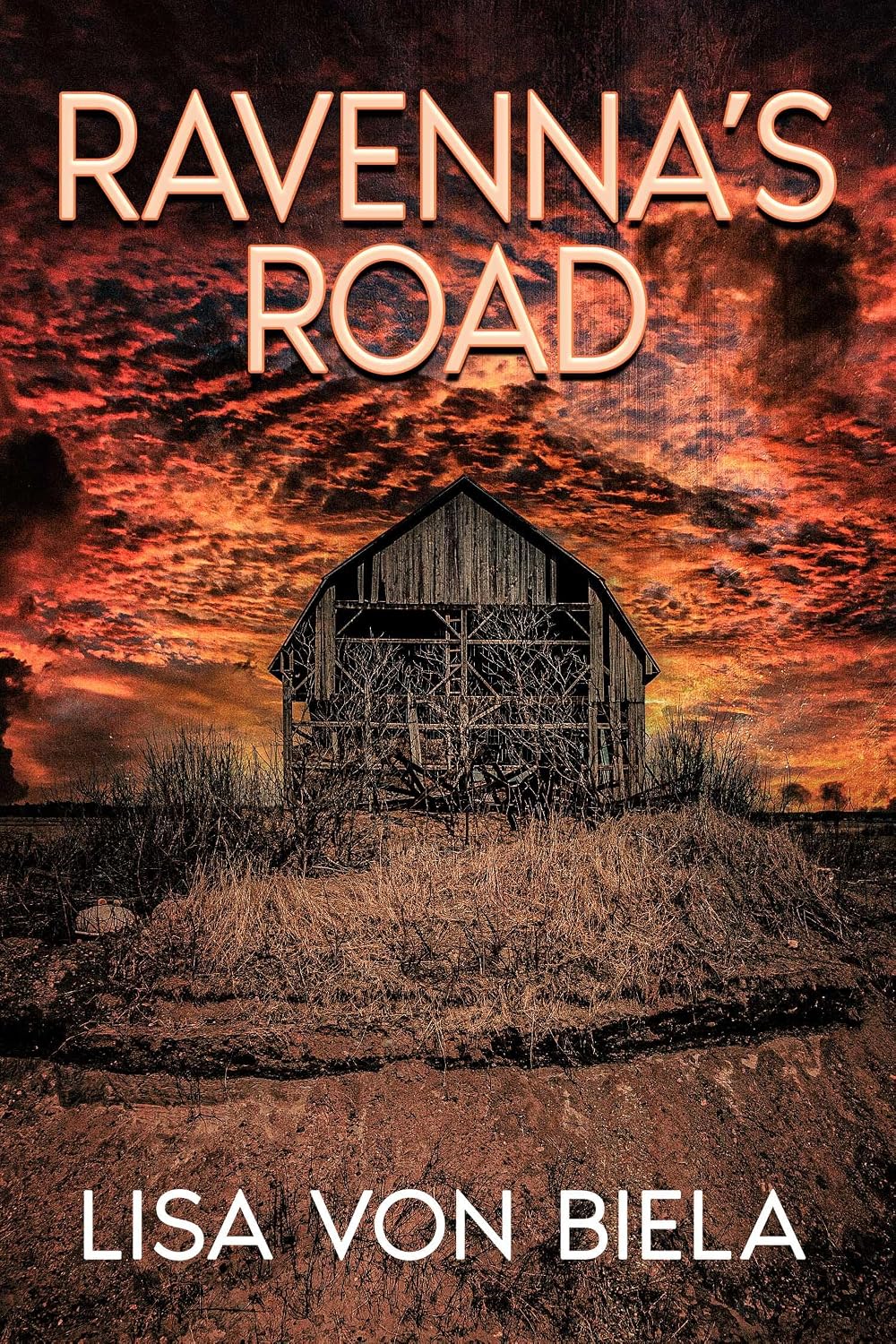
______________
In the not-too-distant future, climate change wreaks havoc on agriculture, the economy, public health, and the very fabric of society. Everything is in short supply: food, water, money—and hope.
Convicted of a murder she did not commit, Ravenna opts for a work-based diversion program in place of prison time. She becomes a first responder in Chicago’s toughest and most desperate section. She faces violence, suicides, and danger on every shift.
One day, Ravenna learns the immense personal sacrifice that led to her conviction was in vain. The discovery drives her to take a risky leap. Determined to make a new life for herself one way or the other, she meticulously plans her escape to Mexico, then sets out on the road.
But she encounters far worse obstacles and dangers than she imagined—and there’s no turning back. Her plan in tatters, she has to find a way to reach a safe place to start over.
Will the road be Ravenna’s salvation—or her undoing?

Into the next phase on my current novel-in-progress…

Yes, it’s been a while since I posted anything. I do not know how people blog daily/hourly/whatever.

Last time I posted about the WIP (work-in-progress), it was at around 17,000 words and things were moving along at a nice pace. I finished the first draft last month. It came in at nearly 71,000 words. I feel good about that. Then we were on vacation for a couple of weeks, then had post-vacation stuff to deal with. So it sat for a bit, which was actually a good thing. Enables me to review the draft with a fresh, critical eye.

I’m back at it now. And I’m not straying from my lane. I’m sticking with the process that has worked for me over the years (unlike my initial attempt at “pantsing” my last novel!). So right now I’m re-reading the entire manuscript, not really touching it except for any super-blatant goofs (wrong words, missing words, nothing beyond that sort of thing). At this stage, I compile what I call a “punchlist” (I’m pretty sure I stole that term from construction). It’s a chapter-by-chapter list of items I need to address in the second draft. It also includes line items that apply more broadly across chapters, or perhaps even across the entire manuscript. The second draft is generally a pretty heavy lift, and this punchlist helps me get the job done most efficiently and with consistency across the entire manuscript.

Yesterday, I reached the halfway point on preparing the punchlist. And that feels pretty good. I know I have a major thing to address in the second draft for this one: a newer-generation implanted chip (new generation of the chip in The Genesis Code). I actually suspended work on the novel earlier this year to take a free online Harvard course in TinyML, thinking it would help inform the technology in the book. It will, but I have to think it through a little more and come up with a consistent approach that I’ll apply throughout the second draft. Second draft also normally includes deepening/expansion of characters, description, setting, and such. It will here, too. My trusty punchlist will help with all that–and will help me ensure that everything is consistent all the way through. Assuming the second draft goes as intended, third draft is typically aimed more at enhancement/refinement/maybe a bit more expansion, and fourth is usually line-by-line editing for any remaining typos, poor word choice, things like that.

So, yeah, I’ve been quiet, but I’ve been busy. I still don’t even have a working title for this one. I may have mentioned, it’s a sequel to both The Genesis Code and Down the Brink. Dr. Tyler and his implantable chip (new generation) returns from Genesis, and Ed Walters from GSI (for-profit prison system) and Sammy Douglas and others return from Down the Brink. It’s a good combination, and timely. Note that while it is a sequel, I’m writing it so the reader isn’t required to have read the prior books, though it would enhance the experience, I would think.

Thanks for reading!

Where to buy:

______________
In the not-too-distant future, climate change wreaks havoc on agriculture, the economy, public health, and the very fabric of society. Everything is in short supply: food, water, money—and hope.
Convicted of a murder she did not commit, Ravenna opts for a work-based diversion program in place of prison time. She becomes a first responder in Chicago’s toughest and most desperate section. She faces violence, suicides, and danger on every shift.
One day, Ravenna learns the immense personal sacrifice that led to her conviction was in vain. The discovery drives her to take a risky leap. Determined to make a new life for herself one way or the other, she meticulously plans her escape to Mexico, then sets out on the road.
But she encounters far worse obstacles and dangers than she imagined—and there’s no turning back. Her plan in tatters, she has to find a way to reach a safe place to start over.
Will the road be Ravenna’s salvation—or her undoing?

The Genesis Code, 13 years old today!

Hard to believe my debut novel, The Genesis Code, came out 13 years ago today. I embarked on writing it around 2004ish. Took me 2 years or so to finish. I’d written short stories. Genesis was my first foray into novel-length work, so a lot of that time was needed to get my sea legs, so to speak.

I made sure to finish it up before I started law school in 2006. I–correctly–presumed I’d have no time to devote to it. I tried to shop it around now and again, to no avail. I didn’t have the time to really make an organized go of that. Law school was all-consuming.

In 2012, Greg Gifune was acquiring novels at DarkFuse. He’d accepted my very first short story (“Vacancy”) for publication in his then-zine, The Edge, back in 2002, so he was familiar with my work. He accepted the novel and scheduled it for publication in May 2012.

The Genesis Code has since been joined by several novellas and a number of additional novels in the intervening years. My most recent, Ravenna’s Road, came out last year. I’m working on the next one now–it’s a sort of sequel for both The Genesis Code and Down the Brink.

My novels, mainly near-future dystopian thrillers of one flavor or another, are available wherever you get your books.

Thanks for reading,

Lisa von Biela

What’s up with the mysterious red X’s painted on abandoned farmhouses and barns?

In several key scenes in Ravenna’s Road, Ravenna encounters mysterious hand-painted red X’s. Early on, she stops for some much-needed rest at an abandoned farmhouse. A red X is painted on the door. Why? She soon finds out. Later on, she finds another red X painted inside an abandoned barn. And that’s not all she finds in that abandoned barn.

Ride along with Ravenna, and find out what’s up with the red X’s. And whether she survives all the dangers she encounters on the road.

Where to buy:

______________
In the not-too-distant future, climate change wreaks havoc on agriculture, the economy, public health, and the very fabric of society. Everything is in short supply: food, water, money—and hope.
Convicted of a murder she did not commit, Ravenna opts for a work-based diversion program in place of prison time. She becomes a first responder in Chicago’s toughest and most desperate section. She faces violence, suicides, and danger on every shift.
One day, Ravenna learns the immense personal sacrifice that led to her conviction was in vain. The discovery drives her to take a risky leap. Determined to make a new life for herself one way or the other, she meticulously plans her escape to Mexico, then sets out on the road.
But she encounters far worse obstacles and dangers than she imagined—and there’s no turning back. Her plan in tatters, she has to find a way to reach a safe place to start over.
Will the road be Ravenna’s salvation—or her undoing?

17,000 words in–and growing fast

OK, so my “outline” for the new book is doing its job and doing it well! I’m already 17,000 words into my first draft in just about 2 weeks. What a lovely, refreshing change from my initial “pantsing” attempt at what became Ravenna’s Road. On that one, I got a few thousand words in–words that I liked–and then got absolutely stuck. Where was I to go from there? A struggle every step of the way until I gave up, outlined it, and moved on. I’m very happy with the result, but not happy it took 5 years to complete!

In contrast, this novel is chugging right along, the outline working exactly as it should. It’s feeling good, things are working. Each outline entry is, in essence, a moderately detailed writing prompt. It tells me which character has POV for that chapter, setting, timeline, what needs to happen/the point of the chapter (a lot of times, I need to “seed” something early on that will tie to something later, all part of the outline plan). It still leaves plenty of room for the “how” of it. How will that character do all those things, how will it take shape, that sort of thing. This enables me to, chapter by chapter (not having to hold the whole book in my head) envision the scene and what needs to happen, then type as fast as I can while viewing it in my mind’s eye. That’s when it all works the best for me, and it’s happening with this novel draft.

Thanks for reading!

Where to buy:

______________
In the not-too-distant future, climate change wreaks havoc on agriculture, the economy, public health, and the very fabric of society. Everything is in short supply: food, water, money—and hope.
Convicted of a murder she did not commit, Ravenna opts for a work-based diversion program in place of prison time. She becomes a first responder in Chicago’s toughest and most desperate section. She faces violence, suicides, and danger on every shift.
One day, Ravenna learns the immense personal sacrifice that led to her conviction was in vain. The discovery drives her to take a risky leap. Determined to make a new life for herself one way or the other, she meticulously plans her escape to Mexico, then sets out on the road.
But she encounters far worse obstacles and dangers than she imagined—and there’s no turning back. Her plan in tatters, she has to find a way to reach a safe place to start over.
Will the road be Ravenna’s salvation—or her undoing?

What does “outline” mean to me?

As I’ve said in other posts, I outline my novels before drafting them. But what do I really mean by “outline”?

You might think it’s a quick little set of bullet points.

And you’d be wrong. Oh, so wrong.

When I outline a novel, I work up the entire plot and key subplots. I identify and do a character sketch for the main characters and key minor characters. I fill in the gaps until I have a full story, start to finish. I make sure things happen in the right sequence. I make sure the proportion of beginning/middle/climax/end is balanced. I make sure the characters get an appropriate proportion of chapters from their POV. It has to make sense, major questions need to be resolved.

When I’m done, I have a list of each chapter, what happens in each chapter and why (motive/how it advances the plot), whose POV it will be in, and a rough timeline so things make sense and I can insert timeline references/clues along the way so the reader understands when it’s “next day” versus months later.

So it’s really more than a mere outline, it’s a chapter-by-chapter account of what’s going to happen. It is a lot of work. I have to hold the entire story in my head as I do it. That’s why I thought I’d try “pantsing” without an outline when I started Ravenna’s Road. Thought I’d save myself some work. But I ended up writing the first few chapters, really liking their tone/execution/mood, but…I got lost in where-do-I-go-from-here land. And ended up doing the outline anyway, and reworking things to get the novel written.

It’s a ton of work, but it pays dividends. Big ones. At least for me. By the time I complete it, I’ve done the heavy lifting, figured out the flow, what happens when and why and by whom. I can then take the drafting chapter by chapter and focus on bringing to life what I already determined would happen in each chapter. So it becomes a ready-make writing prompt for each chapter, where I don’t need to hold the whole story in my head, and can focus on the writing, chapter by chapter.

Not only that, if I need to delete/add/resequence the story to get it right, it’s a hell of a lot easier to do that with an Excel spreadsheet of chapter descriptions than it is with a partly written manuscript! Cut/paste/done, rather than having to rework a partial draft.

Of course, sometimes things take a different direction or I find I did forget something or whatever. That’s what the First Edit round is for. Once I get all the way to the end, I again hold the whole story in my head to do the First Edit. Catch inconsistencies that crept in, remaining gaps, where something isn’t clear or isn’t serving the story after all. First Edit is a big lift, too.

Second Edit incorporates the big fixes identified in First Edit. Third Edit makes sure the new bits are smooth and lets the writing and style breathe some more. Fourth Edit is mostly line editing for grammar, punctuation, repeated words, and final polish.

Of course, there are more editing rounds if something major isn’t working or needs significant expansion. That happened in Scorched Earth. I rewrote/expanded a considerable amount on that one. It needed it. I began writing it during a really distracted period (my publisher was shutting down) and it showed in the initial manuscript. I’m happy with it now, though!

Anyway, just wanted to put this out there. I’m in the “outlining” stage of my next novel right now. It’s getting there. Needs some more expansion in the last third or so, make sure the two subplots breathe sufficiently–and connect in a dramatic, but believeable, way in the end. I’m starting to itch to begin Chapter 1, but I know better than to do that before I finish working out the final kinks and doing justice to the “outline” phase.

Thanks for reading!

Where to buy:

______________
In the not-too-distant future, climate change wreaks havoc on agriculture, the economy, public health, and the very fabric of society. Everything is in short supply: food, water, money—and hope.
Convicted of a murder she did not commit, Ravenna opts for a work-based diversion program in place of prison time. She becomes a first responder in Chicago’s toughest and most desperate section. She faces violence, suicides, and danger on every shift.
One day, Ravenna learns the immense personal sacrifice that led to her conviction was in vain. The discovery drives her to take a risky leap. Determined to make a new life for herself one way or the other, she meticulously plans her escape to Mexico, then sets out on the road.
But she encounters far worse obstacles and dangers than she imagined—and there’s no turning back. Her plan in tatters, she has to find a way to reach a safe place to start over.
Will the road be Ravenna’s salvation—or her undoing?

What would Ravenna do?

Ravenna, the main/POV character (indeed, the entire book is written in her voice, first person) in my latest novel, Ravenna’s Road, has a soft spot.

And that soft spot keeps getting her into trouble.

I won’t tell you why or how (you’ll have to read the book!), but her soft spot lands her in prison for something she did not do. That puts her in a world of trouble in a near-future dystopian prison system. As if that isn’t bad enough, then she goes on the run. And again, her soft spot gets the better of her at a couple of critical points on the road, landing her in yet more hot water to climb out of.

What will happen to her?

Ride along with Ravenna and see what happens…

Where to buy:

______________
In the not-too-distant future, climate change wreaks havoc on agriculture, the economy, public health, and the very fabric of society. Everything is in short supply: food, water, money—and hope.
Convicted of a murder she did not commit, Ravenna opts for a work-based diversion program in place of prison time. She becomes a first responder in Chicago’s toughest and most desperate section. She faces violence, suicides, and danger on every shift.
One day, Ravenna learns the immense personal sacrifice that led to her conviction was in vain. The discovery drives her to take a risky leap. Determined to make a new life for herself one way or the other, she meticulously plans her escape to Mexico, then sets out on the road.
But she encounters far worse obstacles and dangers than she imagined—and there’s no turning back. Her plan in tatters, she has to find a way to reach a safe place to start over.
Will the road be Ravenna’s salvation—or her undoing?

Ravenna’s Road–one helluva road trip

My latest novel, Ravenna’s Road, is out in the wild now. Ravenna tries to escape her untenable situation, and ends up hopping out of the frying pan and right into the fire.

Hard to believe Ravenna’s Road is my 11th title. I’m plotting out #12 even as we speak. It promises to be another dark, dystopian type, quite possibly a sort of sequel to Down the Brink (the darkest thing I’ve ever written, and frighteningly prescient).

If you like your fiction dark, fast-paced, and thought-provoking, check out Ravenna’s Road!

Where to buy:

______________
In the not-too-distant future, climate change wreaks havoc on agriculture, the economy, public health, and the very fabric of society. Everything is in short supply: food, water, money—and hope.
Convicted of a murder she did not commit, Ravenna opts for a work-based diversion program in place of prison time. She becomes a first responder in Chicago’s toughest and most desperate section. She faces violence, suicides, and danger on every shift.
One day, Ravenna learns the immense personal sacrifice that led to her conviction was in vain. The discovery drives her to take a risky leap. Determined to make a new life for herself one way or the other, she meticulously plans her escape to Mexico, then sets out on the road.
But she encounters far worse obstacles and dangers than she imagined—and there’s no turning back. Her plan in tatters, she has to find a way to reach a safe place to start over.
Will the road be Ravenna’s salvation—or her undoing?

Writing a novel is like…

Of course, I’m sure it’s different for different people, but I still recall what it felt like for me when I embarked on my first novel, THE GENESIS CODE.

It felt like hopping into a smallish sailboat alone and just heading out to a point where land was not visible from any side. And then wondering, where the hell am I going and how the hell am I going to get there? And how will I know I got there, for that matter?

Now, it’s not like I was 100% clueless. By the time I felt I was ready to try a novel-length work, I’d written a number of short stories, got some published. But that’s like sailing the boat around a marina–so many fewer words to wrangle. So much less continuity to worry about.

I outlined and prepared, but still hit some points where I really felt asea and panicked. I remember hitting one problem in particular that stopped me in my tracks. I needed one of the characters to do a certain thing for everything to work. But…I realized that character had zero motivation or reason to do that thing. Took me a while to realize that, took me a while longer to solve the problem. My sail was slack, my anchor was missing, and I couldn’t see a trace of land anywhere!

But once I made it through, subsequent novels were easier. I’d made the journey once, I could do it again. I trusted myself.

Then I threw all caution to the wind and decided to try writing a novel without an outline. Other authors do it, and do it well. Why not?

It started out okay, I made it past the breakwater without incident. But it wasn’t long before I felt adrift and terribly lost. It was like the first time, only this time, I’d tossed the compass out before embarking and was regretting it big-time.

I retraced my steps, made it back to the harbor, got a new compass (wrote an outline, that is), and headed out. And finished, though the journey actually took longer in calendar time than it took to write THE GENESIS CODE. Oh, well. I learned, and I’m happy with the final result: RAVENNA’S ROAD. It’s my first novel-length work in first person, and I believe it was the right choice for the story and for Ravenna. I’d be honored if you’d check it out.

Thanks for reading!

Here’s a universal link that takes you to all the sites offering the book, paperback and eBook:  RAVENNA’S ROAD.

In the not-too-distant future, climate change wreaks havoc on agriculture, the economy, public health, and the very fabric of society. Everything is in short supply: food, water, money—and hope.

Convicted of a murder she did not commit, Ravenna opts for a work-based diversion program in place of prison time. She becomes a first responder in Chicago’s toughest and most desperate section. She faces violence, suicides, and danger on every shift.

One day, Ravenna learns the immense personal sacrifice that led to her conviction was in vain. The discovery drives her to take a risky leap. Determined to make a new life for herself one way or the other, she meticulously plans her escape to Mexico, then sets out on the road.

But she encounters far worse obstacles and dangers than she imagined—and there’s no turning back. Her plan in tatters, she has to find a way to reach a safe place to start over.

Will the road be Ravenna’s salvation—or her undoing?

Expanding my artwork/photography offerings: my new Pictorem gallery is *live*!

I’m excited to announce my new gallery at Pictorem, here. I just got everything all loaded and ready to go in the last couple of days. I really like how clean and professional my gallery page looks–I could never get it to look that nice if I tried to do it from scratch. Pictorem takes care of production and order fulfillment, and I just have to do the fun part.

I had begun feeling limited and wanted to expand what I can offer and how. I’ve been on Pixels/Fine Art America for some years now, but there is a limit of 25 images before there is a membership fee. I’ve been on RedBubble for years, too. They offer a lot of different products to put the art on (everything from clothing to mugs to stickers and wall art), but I find the portfolio presentation less than tidy.

I’ve been busy uploading to several microstock sites (Adobe, Shutterstock, Dreamstime), especially since I converted to higher resolution Fuji mirrorless equipment last year and began photographing birds in earnest. But microstock is a special thing, with a particular audience and requirements. For example, they don’t want black & white, since the customer can convert the image to black & white if they so choose. I want to do more black & white work, as well as use more creative effects to come up with truly unique images–you’re not supposed to do that with microstock submissions. So many times, I found myself thinking, well, this shot is great, would look amazing on someone’s wall, but it’s not suitable for stock. Bummer.

So voila, Pictorem. Much broader (and different) audience than microstock, so my art and photography can wind up as beautiful prints on people’s walls–and I can go nuts with black and white and additional effects as far as my creative whims take me. All this without having to deal with production and shipping myself.

My gallery at this point consists of: art (various media, styles, and subjects) and photography (categorized by birds, animals, nostalgia, scenics, B&W, abstract, up close). I’ll keep posting to microstock and the other sites, but I’m really excited about Pictorem and the possibilities it opens up for a broader audience and unleashing more of my creativity!

Now…if only there were more than 24 hours in a day. Gotta work on that.