Yeah, again it’s been a while since I posted. And I still don’t know how people get the time/motivation to post regularly, let alone frequently!
I noticed several of my writing-related anniversaries pop up this month. Every one of them has some form of connection to my current work-in-progress, oddly. So I decided to recognize/celebrate them with a blog post today.
I’ll go chronologically, because that’s just how I roll.
In October 2012, my debut novel, The Genesis Code, was accepted for publication by DarkFuse (they have since closed down, and I’m with Crossroad Press now). Genesis came out in May 2013, and is still out there, republished by Crossroad in all forms (ebook, paperback, and even audiobook!). How is Genesis related to my current work-in-progress, you ask? Well, one of the characters, Dr. Josh Tyler, invented a mind-control sort of implantable chip in Genesis. He will return with a new generation of the darstardly device, powered by more modern technology like AI, TinyML, and so forth. He’s been hanging out since everything blew up on him in Genesis. And he’s finally found a potential customer for his newly designed device.
Down the Brink was published in October 2017. How is that related? The current work-in-progress is a sequel to Down the Brink (though I’m writing it so the reader doesn’t have to have read Brink first), with Dr. Tyler from Genesis joining in. Down the Brink still reigns supreme as the darkest book I’ve ever written. It’s about a for-profit prison system, along with a covert scheme to feed the pipeline-to-prison. The work-in-progress picks up where Brink left off, and let’s just say Dr. Tyler gets involved because he has something to offer that GSI (the fictional for-profit prison operation) needs.
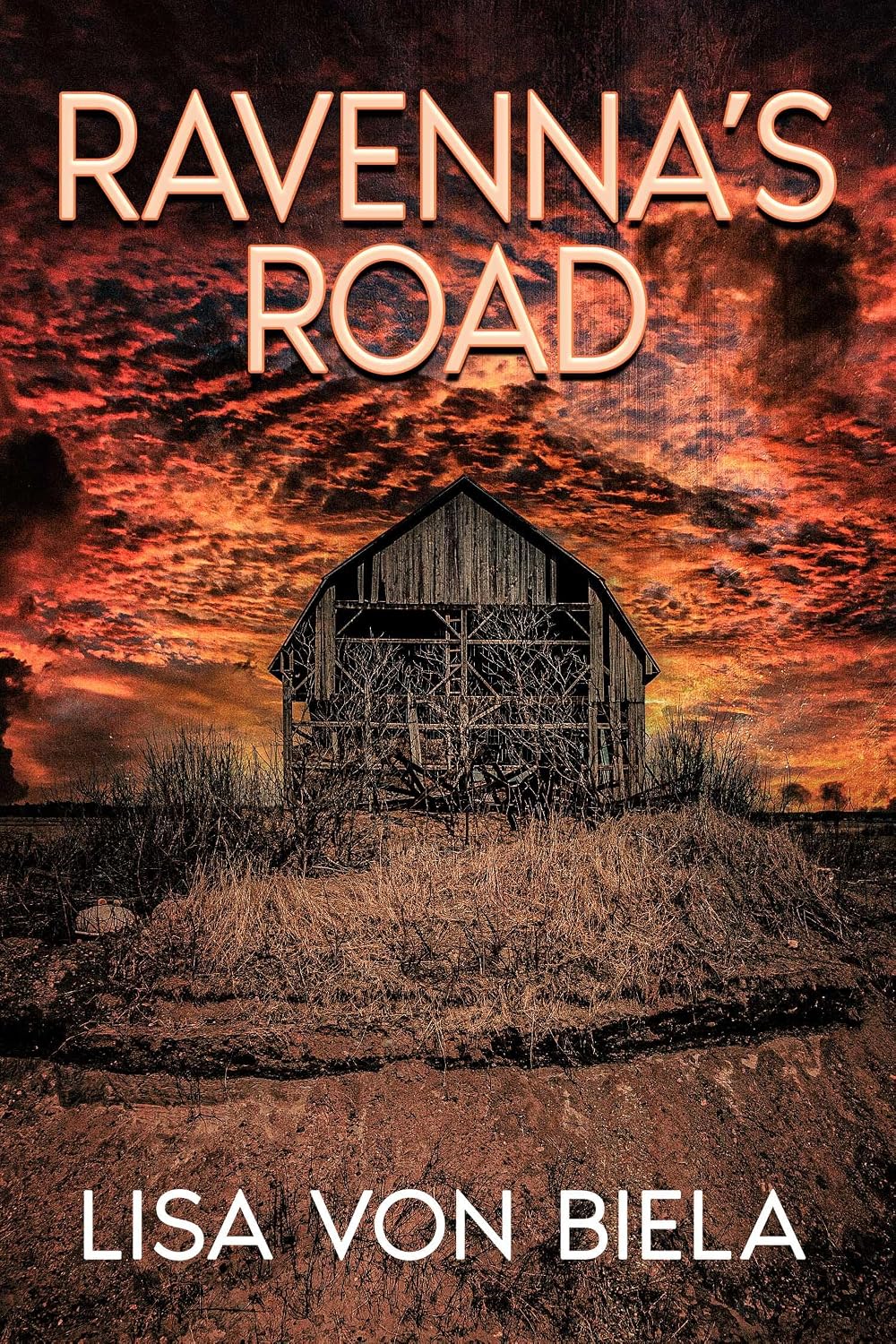
October 2024 marks the anniversary of completing the manuscript for Ravenna’s Road, my most recently published work. It took me 5 years to complete! Five years! Longer than my debut novel, when I was feeling my way around trying to write a work of that length for the first time. There were a lot of reasons for this. I started it right before the pandemic hit. The pandemic was not only a distraction for all the obvious reasons, but it also gave me pause about writing my usual stuff. I lean toward dystopian thrillers of various flavors (BigAg, BigPharma, climate change, etc.). Did the world need more of that right then? I really didn’t think so. The other problem is a lot of my books actually come true. Yep. Brain chip in Genesis? DARPA came out with one several years later. The enormous fire that burned down the whole panhandle of Nebraska in Scorched Earth (when I wrote it, I thought I was being WAY over the top)? Yeah, think of the huge fires in Australia, California. A little too close to what I thought was wild fiction while I was writing it. So I was feeling a little superstitious that I didn’t want to add to the world’s troubles by having another book come out that came true. So I studiously avoided anything like contagion/pandemic in Ravenna’s Road. Oh, it’s still plenty dystopian, but just avoids those sorts of tropes for that reason.
Another reason Ravenna took so long is the current state of affairs in publishing. There is so much out there, and so few people seem to read anymore, it’s sort of a “what’s the point?” problem for me. Self-publishing has been a two-edged sword, in my opinion. I appreciate the control it gives you (and I did self-publish one novella, Moon Over Ruin, as well as my book on foreclosure prevention, Don’t Say I Didn’t Warn You: Homeownership Decisions That Can Cost You Your House). But it also lets anybody put out anything without any sort of vetting. So the quality can be, well, unpredictable. And it contributes to the sheer volume of stuff out there for potential readers to wade through to find my stuff.
And don’t get me started on AI, and just generating novels from nothing in a snap. And stealing, too. Seven of my works were in the Anthropic list, so don’t get me started on theft.
All of these factors work together to make it all the harder for real/human authors to have their work seen and appreciated. So, to be brutally honest, there is a huge “why bother?” factor that contributed to Ravenna taking so long. And it’s still at work today. The first draft of the current work-in-progress went fairly quickly and I felt good about the quality (for a first draft). I read through the whole thing and created a list of things to address globally and per chapter to get things consistent, get the bones of the thing in all the right places. I’m working on the second draft now, and it’s not gone quickly. Yes, there is some heavy lifting to address (example: one character in the original draft that needs further development and a bigger role in the final product, so there are some new chapters to be written). There always is this sort of work to be done in the second draft, for me, the way I tackle a novel.
But there is also a lot of “why am I doing this?” going on. That slows things down, for sure. But I refuse to use AI to speed it up. The end result will be *my* work. Period.
And then there are moments like yesterday. I was working on a chapter where that character needs to be fleshed out more. I knew I needed to tell the reader what her career was before landing in prison, and what she landed in prison for (spoiler: she didn’t do it, really didn’t do it!). I didn’t want to do an infodump, but I needed to get that information in. And I did it in less than a sentence. Ha!!! Bang, there it is, and I can build on it in subsequent chapters involving her.
Anyway, that’s all I have to say today. Give Ravenna’s Road (or any of my other titles) a try while you wait for the latest one (it’ll be a while, seeing as I’m only at the second draft right now!).
Thanks for reading!
Where to buy: